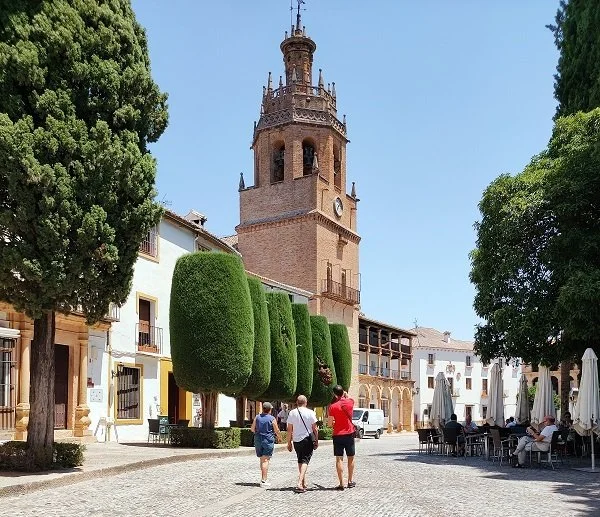
Why Ronda is worth the trip
Ronda is one of Andalusia's oldest and most spectacular towns, split in two by the El Tajo gorge and stitched back together by the famous Puente Nuevo bridge. Sitting at around 750 metres above sea level in the Serranía de Ronda mountains, it feels a world away from the coast, yet it is close enough to Málaga to see comfortably in a single day. You get whitewashed old streets, Moorish heritage, clifftop viewpoints and one of Spain's most historic bullrings, all within easy walking distance of each other.
How to get to Ronda from Málaga
 Guided bus tour to RondaCheck availability →
You have three realistic options: bus, train or car. The bus is usually the fastest and most frequent public-transport choice, the train is the most scenic, and driving gives you the freedom to stop in the white villages along the way.
By bus (fastest and most frequent)
Buses leave from Málaga's María Zambrano bus station, next to the main train station, and are operated by companies such as Avanza and Damas. The direct services are the quickest way to reach Ronda by public transport, and there are frequent departures spread across the day, so you are rarely tied to a single timetable.
- Journey time: roughly 1h30 on the fastest direct services, around 1h45 on average
- Fares: from about €12 one way when booked in advance
- Frequency: multiple daily departures, with early-morning services ideal for a day trip
- Arrival: Ronda bus station is about a 10-minute walk from the old town and the bridge
By train (the scenic route)
Trains depart from Málaga-María Zambrano station and run on Renfe's Media Distancia regional line. The ride is genuinely beautiful, climbing through mountains, tunnels and river valleys, but it is slower and less frequent than the bus, so plan around the timetable rather than turning up on spec.
- Journey time: around 2 hours
- Fares: from roughly €12 one way, depending on the service and how far ahead you book
- Frequency: only a handful of departures per day, so check return times carefully
- Tip: some services may involve a connection, so review the itinerary before you buy
By car (best for the white villages)
Driving takes about 1h30 and is the best choice if you want to combine Ronda with the surrounding countryside. The mountain road winds through dramatic scenery, so allow a little extra time and drive it in daylight if you can. The real advantage is flexibility: you can add a stop in one of the nearby white villages.
- Driving time: approximately 1h30 each way
- Setenil de las Bodegas, famous for houses built into the rock, is only about 20 km (a 20-25 minute drive) from Ronda
- Parking: use the paid car parks near the centre, as old-town streets are narrow and largely restricted
- Best for: travellers who want to see more than one town in a day
Top things to see in Ronda
Ronda's highlights are compact and walkable. Even on a day trip you can comfortably cover the main sights at a relaxed pace.
Puente Nuevo (the New Bridge)
The 18th-century Puente Nuevo is Ronda's defining image, spanning the roughly 100-metre-deep El Tajo gorge and linking the old Moorish quarter with the newer town. It is free to walk across. For the classic postcard view looking up at the full height of the bridge, follow the path down towards the Mirador viewpoints below.
Plaza de Toros (the bullring)
Built in 1785 and run by the Real Maestranza de Caballería de Ronda, this is one of the oldest and most important bullrings in Spain. You can visit the arena and the on-site bullfighting museum, and the audio guide is available in more than a dozen languages, English included. A visit takes roughly 45-60 minutes.
- Admission: around €8-9, typically including the audio guide
- Opening hours vary by season, broadly 10:00-20:00 in spring and summer and 10:00-18:00 in winter
- It may close to visitors during the September feria
Arab Baths (Baños Árabes)
Down in the old quarter near the river, the 13th-century Arab Baths are among the best-preserved medieval hammams in Spain, with vaulted rooms, star-shaped skylights and remnants of the original water system. A short 3D video explains how they worked before you walk through.
- Admission: around €4.50 for adults
- Free entry is often offered on Tuesday afternoons
- Opening hours vary by day and season, so check before you go
Alameda del Tajo, viewpoints and the old town
The Alameda del Tajo is a clifftop garden with sweeping views over the valley and the mountains beyond, and it is free to enter. From there, wander the cobbled streets of the old town past historic mansions, churches and small wine shops. Both areas are easy to combine with the bridge and the bullring in a single loop on foot.
What to eat in Ronda
Ronda is mountain country, and the food reflects it. Look for rabo de toro (slow-cooked oxtail stew), migas rondeñas (fried breadcrumbs with local accompaniments) and the area's cheeses and wines. The Serranía de Ronda is a recognised wine region, so a local red pairs naturally with a long lunch between sightseeing.
Practical tips for your day trip
- One day is enough to see the main sights, but arrive early to beat the coach-tour crowds around the bridge
- Wear comfortable shoes: the streets are cobbled and there are slopes down to the gorge viewpoints
- Bring a light jacket, as Ronda sits at altitude and is cooler than the coast, especially in the morning and evening
- Carry some cash for smaller sites and cafés, though cards are widely accepted
- It is a safe, walkable and family-friendly destination