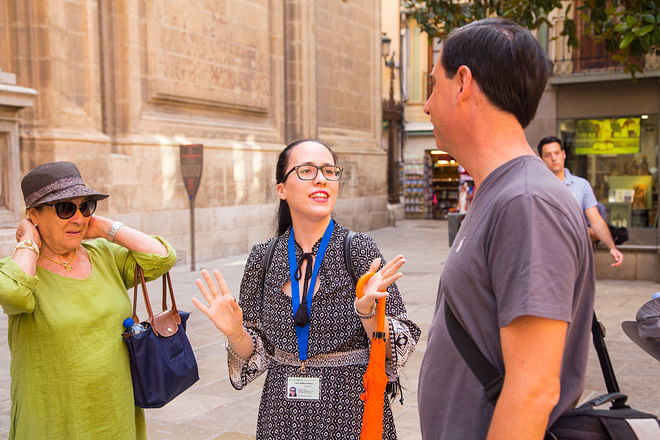
Few Andalusian cities read as well on foot as Málaga. Its historic centre is compact, largely pedestrianised, and packs two thousand years of history into less than a square kilometre: Phoenician walls, a Roman theatre, an Andalusi alcazaba, a Renaissance cathedral and the house where Picasso was born. This route takes you through the essentials in a comfortable walk of 2 to 3 hours, which you can extend as much as you like if you go inside the monuments.
How to get there and where to start
The old town is almost entirely pedestrianised, so it's best to leave the car behind. If you arrive by high-speed train or Cercanías, María Zambrano station is about a 15-minute walk from the centre. By metro, lines 1 and 2 drop you at Atarazanas station, next to the market and just a step from Calle Larios. From the airport, the C-1 Cercanías line connects to the centre in a few minutes. The natural starting point is Plaza de la Constitución, the nerve centre of the city since medieval times.
The route, stop by stop
Complete Malaga old town walking tour with admission tickets includedCheck availability →These are the seven stops that make up the walk. They're linked together logically, with hardly any detours, so you can follow them in order and not miss anything important:
- Plaza de la Constitución: the historic centre and starting point, surrounded by stately buildings and cafés with outdoor seating.
- Calle Marqués de Larios: the great pedestrian and shopping thoroughfare, elegant and always lively, linking the square to the port.
- Málaga Cathedral (La Manquita): the Renaissance jewel, recognisable by its unfinished south tower.
- Museo Picasso Málaga: housed in the Palacio de Buenavista, amid the tangle of narrow streets off Calle San Agustín.
- Alcazaba and Roman Theatre: the monumental complex that sums up Roman and Andalusi Málaga.
- Calle Alcazabilla: a pedestrian walk at the foot of the Alcazaba, with the Roman Theatre in view.
- Plaza de la Merced: a lively square and the end of the route, home to Picasso's birthplace.
Calle Larios and Plaza de la Constitución
Start at Plaza de la Constitución and head down Calle Marqués de Larios, Málaga's most photographed street. Laid out in the late 19th century with a stately air reminiscent of grand European avenues, today it's a marble-paved shopping promenade where it's worth looking up: its uniform façades are part of the charm. At Christmas and during the Film Festival, it becomes the setting for the city's most crowded light displays.
Málaga Cathedral (La Manquita)
Heading back east, you reach the Cathedral, a Renaissance church of colossal proportions whose south tower was left unfinished, hence the affectionate nickname La Manquita ('the one-armed lady'). You can admire it from outside for free, or go in to see the interior and, if you fancy the views, climb up to the rooftops. General admission with audio guide costs €10, with reduced rates of €9 for over-65s, €7 for students aged 18 to 25 and €6 for young people aged 13 to 17; Málaga residents get in free. Opening hours are extended in summer: from June to October it opens Monday to Friday from 10:30 to 20:00, Saturdays until 18:00, and Sundays from 14:00 to 18:00.
Museo Picasso Málaga
A few metres away, in the Palacio de Buenavista, is the Museo Picasso Málaga, a must in the painter's home city. Admission to the permanent collection costs €13, with a reduced rate of €11 for over-65s, Carné Joven holders and students under 26. General opening hours are 10:00 to 19:00 from March to June and from September to October, extending to 20:00 in July and August, and reducing to 18:00 from November to February, open every day of the week. Last entry is 30 minutes before closing.
Alcazaba, Roman Theatre and Calle Alcazabilla
The most monumental stretch of the walk. At the foot of the hill lies the Roman Theatre, dating from the 1st century, which you can view from the pedestrian Calle Alcazabilla next to its Interpretation Centre. Above it rises the Alcazaba, Spain's best-preserved Andalusi fortress, with terraced gardens, courtyards and viewpoints over the port. There's individual admission to the Alcazaba and to the Gibralfaro Castle that crowns it, as well as a combined ticket for both monuments; check current opening hours and prices before heading up, as they vary by season.
Plaza de la Merced, the end of the route
The walk ends at Plaza de la Merced, one of the liveliest squares in the centre, presided over by the obelisk to Torrijos and ringed by outdoor terraces. Pablo Picasso was born here in 1881: his birthplace, on one side of the square, is now a museum space. It's the perfect spot to sit down, have a drink and wrap up the walk, or to keep climbing towards the Gibralfaro viewpoints if you've still got the energy.
Practical tips for your route
- Go early or late in the day: in summer the centre gets crowded at midday and the monuments fill up by mid-morning.
- Comfortable footwear: the cobbled streets and the climb up to the Alcazaba call for it.
- Buy your Cathedral and Picasso Museum tickets online to avoid queues in high season.
- Take advantage of the free-entry windows: early mornings at the Cathedral and the last two hours on Sundays at the Picasso Museum.
- The route is family-friendly: there are open spaces, terraces and spots to rest.
- Set aside half a day if you want to take your time visiting all three major monuments.