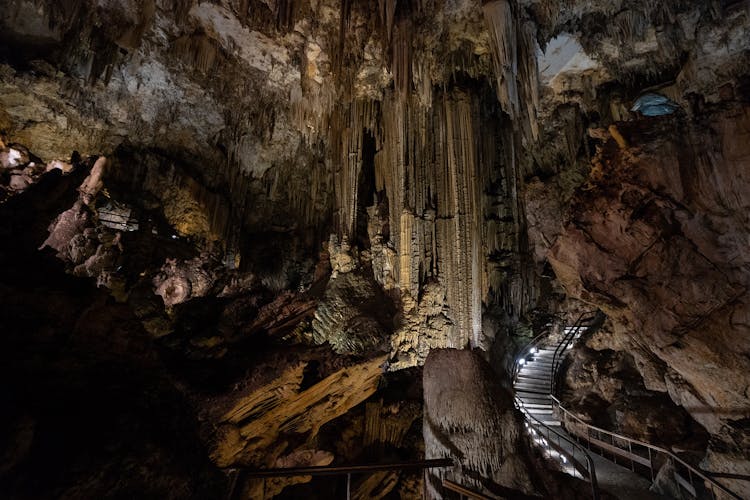
When the coast gets too hot, head underground. The caves around Málaga stay at a steady 18-20°C year-round, and they range from an easy self-guided walk you can reach by city bus to remote prehistoric galleries you explore by lantern. Below you'll find each cave with its verified 2026 hours, prices in euros and how to get there, so you can plan a half-day without any surprises at the ticket desk.
Cueva del Tesoro (Rincón de la Victoria)
This is the closest cave to the city and the easiest to reach without a car. It's also a geological rarity: one of very few caves in the world formed by the sea rather than by fresh water, so instead of the usual dripstone forest you walk through smooth, rounded chambers carved by ancient waves. The name means 'Cave of the Treasure' after a legend that Moorish gold lies hidden inside. The visit is self-guided and takes roughly 45 minutes to an hour, which makes it an easy pairing with a beach afternoon in Rincón de la Victoria.
Opening hours are seasonal. In summer (1 May-30 September) it opens 10:30-13:00 and 16:30-19:00; in winter (1 October-30 April) it opens 10:00-13:00 and 15:00-17:00. General admission is 4.65€ for adults. There's also free entry Monday to Friday during the first opening hour if you reserve ahead, with places capped at 25 people.
How to get there: the cave sits at Avenida del Cantal Alto in Rincón de la Victoria, about 15 minutes east of Málaga by car. Without a car, take the interurban bus line M-160 (Málaga-Rincón de la Victoria-Cotomar) from the Muelle Heredia station; a single fare is around 1.70€ and you get off at the Cantal Bajo-Cueva del Tesoro stop.
Cueva de Nerja
The most famous cave in the region and, for many, the most spectacular. Discovered in 1959, it stretches for kilometres, though a well-lit gallery of about a kilometre is open to visitors. The scale is the draw: cathedral-sized chambers and one of the world's largest known stalactite columns, tens of metres tall. Allow around 45 minutes for the circuit, plus time for the small on-site museum and the VR experience included with your ticket.
The cave opens almost every day of the year, closing only on 1 January, 6 January, 15 May and 25 December. Hours run 9:15-16:30 (last entry 15:30) for most of the year, extending to 9:15-17:30 (last entry 16:30) in summer (June-September), at Christmas, on holiday weekends and during Easter week. Adult tickets bought online are 16€ off-season and 18€ in the summer/peak period; at the door they rise to 18€ and 20€. Children's tickets scale by age, and under-2s go free. There's also a small daily allocation of free tickets Monday to Friday at 9:30 for EU visitors, limited to 60 places.
How to get there: Nerja is about an hour east of Málaga. Frequent Avanza/Alsa buses run from Málaga's main bus station, next to María Zambrano railway station, with journeys from roughly 45 to 90 minutes and one-way fares from around 4.50€. From Nerja's bus station the cave is a short ride or a longer walk uphill.
A quick clarification you'll see repeated online: the famous Festival Cueva de Nerja, the summer classical music and dance festival, is no longer staged inside the cave itself to protect it. Since the 2010s the concerts take place at the open-air Auditorio Manuel del Campo right beside the cave. It still runs each summer, but check the official programme for the current year's dates and line-up, which are usually announced in spring.
Cueva de Ardales
If you're driving inland, especially if you're already visiting the Caminito del Rey, Ardales is the cave for prehistory lovers. Its walls carry cave art created by our ancestors over tens of thousands of years, and it has been at the centre of research into Neanderthal use of pigment. This is not a casual walk-in attraction: access is by guided tour only, in small groups, and must be booked ahead.
Guided visits run Tuesday to Sunday at 10:00, with extra 16:00 tours on Fridays and Saturdays; it's closed on Mondays except public holidays. Admission is 15€ for anyone aged 12 and over and 5€ for children between 8 and 12. Reserve by phone on 952 45 80 46 (Tue-Sun, 8:30-14:30) or by email at patrimonio@ardales.es. Note the format: you meet your guide at the Centro de la Prehistoria de Ardales (Avenida de Málaga 1), then follow in your own vehicle about 4 km to the cave itself. The underground part lasts around two hours, and the whole experience about three.
Cueva de la Pileta (Benaoján)
The most atmospheric of the four and the most adventurous. Near Benaoján in the mountains beyond Ronda, La Pileta has no electric lighting: you explore by the light of lanterns handed out at the entrance, following a local guide, exactly as its Paleolithic paintings of animals and symbols were meant to be seen. It's family-run and gloriously low-key, a genuine step back in time.
Visits are guided, in groups of no more than 25, and admission is 10€ for adults and 6€ for children aged 5 to 10. Booking isn't strictly required but is strongly advised, as group sizes are capped and it's a long way to come to be turned away. Contact the cave on 952 167 343 to check current tour times and reserve.
How to get there: La Pileta is roughly an hour and a half from Málaga, up in the Serranía de Ronda. There's no practical public transport to the cave door, so plan on driving. The final approach is a narrow mountain road followed by a short uphill walk to the entrance.
Practical tips for visiting caves near Málaga
- Dress for 18-20°C: caves stay cool even in August, so bring a light layer even if you leave the coast in shorts.
- Wear closed shoes with grip. Floors are uneven and often damp, and Ardales and La Pileta require proper footwear.
- Book ahead for the guided caves (Ardales and La Pileta) and buy Nerja tickets online to save money and secure a slot.
- No flash photography and never touch the formations or paintings; the oils on your skin damage them permanently.
- Cueva del Tesoro is the only one you can realistically reach without a car; the others reward, or require, driving.